 A little bit of Rhino, a little bit of Illustrator and Voila!
Showing posts with label 4.1.2 Storage. Show all posts
Showing posts with label 4.1.2 Storage. Show all posts
Tuesday, November 10, 2009
Exploded Axon/Performance Diagram of Silo
A little bit of Rhino, a little bit of Illustrator and Voila!
Friday, November 6, 2009


 In the latest interation, the envelope gradates (gradates is not a real word, but you get my point) from top to bottom, the top being more solid and the bottom more porous. I am also playing with lighting based on the color palette we've chosen. The last image is from a previous rendering, however, it illustrates the configuration of the site with multiple silos.
Elevation of Silo with supporting elements
 I threw together a scene that we can use to illustrate the silo in elevation. The bikes and trees were added to give it a sense of place and function. I imagine for our final image we can rev it up and incorporate the Copenhagen skyline into the background. Colors, graphics and supporting images are subject to revision.
Wednesday, November 4, 2009
foto shopping spree
...is not coming along as quickly as planned. As I mentioned Sunday, in a rare turn of events, my office is extremely busy right now so I haven't been able to invest my mornings (as I normally would be able to) toward non-work-related efforts.
Here's a teaser using one of Brandon's recent photos that I liked:

Too Batman-esque?
Obviously this image lacks at least one critical thing: bikes. I was working on re-colouring some bikes to appear as though they are part of our bike share program but didn't finish yet..
Please offer your two cents regarding the color, placement, scale, yadda yadda yadda...
Here's a teaser using one of Brandon's recent photos that I liked:

Too Batman-esque?
Obviously this image lacks at least one critical thing: bikes. I was working on re-colouring some bikes to appear as though they are part of our bike share program but didn't finish yet..
Please offer your two cents regarding the color, placement, scale, yadda yadda yadda...
scanning bollard
Heres a few images from the scanning bollard I sketched-up on ssssKetchup:

It's eleven feet tall with the top three feet being illuminated... The RFID reader is embedded into the base of the illuminated portion, about 8 feet up, giving it a clear "view" of all the nearby bikes.

The interface is touch-screen with a cc slider, number pad for manual entry, and of course a small RFID reader for euro cc's that are equipped with RFID tags already.

Communications equipment can be stored in the top of the illuminated portion as to communicate with the network as a whole...

Of course you gotta add a Danish flag somewhere...
I'm going to photoshop these into some of brandon's photos, or others I can find of sleepier neighborhoods...
See y'all tomorrow.

It's eleven feet tall with the top three feet being illuminated... The RFID reader is embedded into the base of the illuminated portion, about 8 feet up, giving it a clear "view" of all the nearby bikes.

The interface is touch-screen with a cc slider, number pad for manual entry, and of course a small RFID reader for euro cc's that are equipped with RFID tags already.

Communications equipment can be stored in the top of the illuminated portion as to communicate with the network as a whole...

Of course you gotta add a Danish flag somewhere...
I'm going to photoshop these into some of brandon's photos, or others I can find of sleepier neighborhoods...
See y'all tomorrow.
Tuesday, November 3, 2009
Silo Update

In the latest rendering of the silo, the exterior facade comes to a point at the apex of the structure. It kind of resembles an inverted zipper.
 I made a rough pass designing an alternative envelope for the silo. Concerning the formal qualities of the silo, I am less concerned about the mechanics and more interested in making it look sexy. There have been some elements that I have removed for the time being just to flush out the design. We can always reincorporate those elements later. As for the mechanical belt perched at the top of the silo, I think it can be concealed within the shaft of the silo. I know it is purely superficial, but I aim to make the final product slightly asymmetrical.
Wednesday, October 28, 2009

...look what i made!
This is what I've been working on the past few days:


I've got a .skp file i can e-mail if anyone wants to play with it and get a specific view. I'm going to work on building the silo in sketchup (finally) today/tonight and then I'm going to photoshop them into some of the images Brandon took so they look at home, and that should provide us with some good visual material for the booklet/boards.
Please let me know what you think about this scheme for a "satellite hub" to the share system. Each Bollard is a stand-alone unit that is hard-wired into the municipal utilities, and is a secure way to store the Kø bikes as well as privately owned bicycles.
Features:
I figured the lock ring going around the head tube was the simplest and most efficient manner for locking given the propensity for trash and scum to collect in those wheel-slot locking systems. I think we should definitely use more economical anti-wheel-theft solutions such as keyed skewers:

The maintenance worker could be the only ones with access to a key that would release the wheel.
Also, I know the bike is red and not yellow like in Philip's diagrams, but a.) that color can be quickly changed in sketchup; and b.) red or yellow bollards look either like safety equipment or dumb so blue, being the next primary color, worked best and looked the nicest to me, but then with a bunch of yellow bikes all around it started to look like a lo-fi IKEA ad.
Finally, I know the bike isn't quite the same as Philip's design, I tried to find a model of a city bike that I could tweak to look like ours but this was as close as I could get without surpassing my abilities in sketchup/modeling for days on end...


I've got a .skp file i can e-mail if anyone wants to play with it and get a specific view. I'm going to work on building the silo in sketchup (finally) today/tonight and then I'm going to photoshop them into some of the images Brandon took so they look at home, and that should provide us with some good visual material for the booklet/boards.
Please let me know what you think about this scheme for a "satellite hub" to the share system. Each Bollard is a stand-alone unit that is hard-wired into the municipal utilities, and is a secure way to store the Kø bikes as well as privately owned bicycles.
Features:
- RFID Reader aligns with head-tube of Kø bike (where RFID tag will go) and communicates with the real-time database for the online component.
- Powder coated steel bollard and lock-ring adequitely resist corrosion in harsh and salinated conditions (seaside)
- User Interface features standard 10 button numerical pad for manual operation (non-member use), a short-range RFID reader compatible with bank cards and membership card, a magnetic strip swipe for standard bank/credit cards; and a big, friendly screen for visual confirmation and information.
- A happy looking flower pot is integrated into the top of the prefabricated bollard and filled with soil and a nice flower. The pot drains through a week-hole (not modeled) at the base of the bollard to allow for the plant's natural aspiration from both above and below.
- Nice blue colour mimics that of the copenhagen bike lanes, reaffirming their connection to Copenhagen's transportation and ambulation network.
I figured the lock ring going around the head tube was the simplest and most efficient manner for locking given the propensity for trash and scum to collect in those wheel-slot locking systems. I think we should definitely use more economical anti-wheel-theft solutions such as keyed skewers:

The maintenance worker could be the only ones with access to a key that would release the wheel.
Also, I know the bike is red and not yellow like in Philip's diagrams, but a.) that color can be quickly changed in sketchup; and b.) red or yellow bollards look either like safety equipment or dumb so blue, being the next primary color, worked best and looked the nicest to me, but then with a bunch of yellow bikes all around it started to look like a lo-fi IKEA ad.
Finally, I know the bike isn't quite the same as Philip's design, I tried to find a model of a city bike that I could tweak to look like ours but this was as close as I could get without surpassing my abilities in sketchup/modeling for days on end...
Thursday, October 22, 2009
surface area diagram
a diagram depicting the advantages of the surface area Kobenhavn will gain when instituting our proposal for bike storage. our silos provide a solution to the overcrowding in the existing condition.


Wednesday, October 21, 2009
Bike Silo Renderings


 Here are the first rough renderings of the exterior envelope of the silo. I know there has been dispute over the size of the hexagons. However, due to the limitations of my computer, i.e. lack of RAM, I have to resort to using a larger hexagons in order to render within a reasonable amount of time.
 Erik, your sketches are very helpful in establishing the overall concept. I like the idea of having a daytime and nighttime rendering of the silo depot within context of the city. There will be more images to come.
Saturday, October 17, 2009


Wednesday, October 14, 2009
...Bike Silo (in the nick of time)
Hey,
I managed to make use of my boss' absence today and bang out a plan and section of the bike silo in CAD. Check it out---->

(click to check out the largeness)
This is a nine story tower of bikes and has a maximum capacity of 270 bicycles (30 per level)!!!! This one is nearly eighty feet tall from the top of the giant cog to the ground; but obviously it can be made lower in conformation with the surrounding structures..
Unfortunately I'm not going to have time to print this out for tonight so I'm e-mailing out a PDF copy of it so we can at least look at it on the computer... Its 1/4"=1'-0" scale on ARCHD paper (24x36)
I managed to make use of my boss' absence today and bang out a plan and section of the bike silo in CAD. Check it out---->

(click to check out the largeness)
This is a nine story tower of bikes and has a maximum capacity of 270 bicycles (30 per level)!!!! This one is nearly eighty feet tall from the top of the giant cog to the ground; but obviously it can be made lower in conformation with the surrounding structures..
Unfortunately I'm not going to have time to print this out for tonight so I'm e-mailing out a PDF copy of it so we can at least look at it on the computer... Its 1/4"=1'-0" scale on ARCHD paper (24x36)
bike silos coming along smoothly
here's a jpeg of a PDF of the receptacle that bike silo patrons will encounter (in elevation).. the tags and leaders are intended for our benefit only (obviously someone more apt at graphic programs will have to "sex up" my dwgs), I wouldn't want our submission to be as dry as CAD.
Anyway, I'm hoping to have a section and some details (maybe) of the silo itself by tonight... I just had to figure out this thing so I can extrapolate the appropriate size and mechanics of the silo.
More to come...
Anyway, I'm hoping to have a section and some details (maybe) of the silo itself by tonight... I just had to figure out this thing so I can extrapolate the appropriate size and mechanics of the silo.

More to come...
Tuesday, October 13, 2009
STORAGE: green wall [images]
wire mesh


ivy, greenery
porous
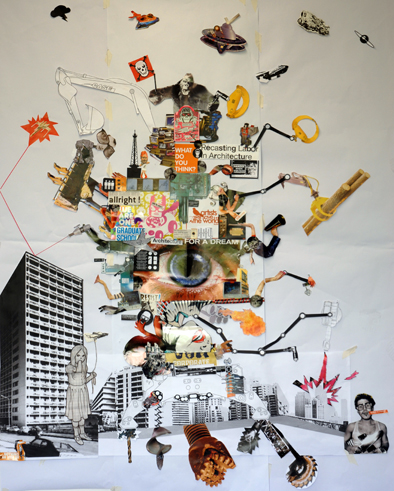
a quick collage with the Copenhagen skyline [to be worked on further]:

Monday, October 12, 2009
SMIT's GROW

All this talk about ivy covered bike silos and solar and wind power harvesting has me thinking about the group SMIT and their research product GROW. The team was founded by a Pratt ID student and his sister the main product of the venture being his thesis project. I do believe most of us know their newest partner Ben Howes who graduated from Pratt architecture in '06. The system uses bio-mimicking leaf shaped pieces to harness solar and wind power.
"...GROW employs thin film photovoltaics with piezoelectric generators and screen printed conductive ink encapsulated in ETFE fluoropolymer lamination... Based around a modular brick system, GROW is composed of a small number of different parts. Each brick has 5 solar leaves which have a very flexible piezo generator at their stem. The manufacturing of these bricks could happen in a roll to roll printing process where PV, conductive ink, and piezo generators can be layered quickly and efficiently. The rolls can then be stamped and formed to create leaves and connection points. Each brick is designed so that at the end of their life cycle the valuable components, i.e. photovoltaic and piezo, can be stamped out and up cycled while the reusable material, i.e plastic, can be up recycled back into the production stream."
This is the blog from their early days in the venture and their current official site. Their solar ivy is due out this fall as a full working prototype/product line.

... and they have already had a piece of the Copenhagen action, they exhibited in the CPH Design Week 09.
Thursday, October 8, 2009
RFID
I was writing back and forth with my brother and he has explained to me the infeasibility of GPS units in the bicycles. This is because of several good reasons:

This company I found, SMARTRAC, makes different RFID products for handling information as simple as a serial number to as complicated as bank account information. Lamenting the impracticality of GPS (which would be a really cool, though cliche) I had an idea:
At races of all kind RFID is used determine the exact start and stop times of individual racerswith sensors over or next to the roadway.... Why don't we do the same thing here. like cellphone relay boxes, a powered RFID reader could ascertain in real-time the number and information of bikes passing that point. This isn't nearly as cost prohibitive of a system as GPS in thousands and thousands of bikes that will all conceivably somewhat different (especially if we dredge bikes out of the harbor). They could be attached like parasites on the sides of lamposts, that would feed a multitude of information (speed, direction, time, density relative rideable lane width, etc...) to a central database, as well as function with our zip-car styled share network online.
It could be like the bike counter that was mentioned here a while back

Also, I hate to plagarize, but the latest post about a bike parking area in DC uses a really clever rack system whose function is very clever... this pic pretty much says it all:

Anywho, thats what I've been doing recently, sorry about not making it last night... see y'all sunday.
- cost prohibitive; the cost of outfitting a bike with GPS cound cost more than the bike itself.
- not maintenance free; how would you service it if it was embedded in the frame for theft reasons?
- power; establishing a way to provide enough power to send/receive data requires more than a hub generator... lights only take a few watts but GPS is a different story.

This company I found, SMARTRAC, makes different RFID products for handling information as simple as a serial number to as complicated as bank account information. Lamenting the impracticality of GPS (which would be a really cool, though cliche) I had an idea:
At races of all kind RFID is used determine the exact start and stop times of individual racerswith sensors over or next to the roadway.... Why don't we do the same thing here. like cellphone relay boxes, a powered RFID reader could ascertain in real-time the number and information of bikes passing that point. This isn't nearly as cost prohibitive of a system as GPS in thousands and thousands of bikes that will all conceivably somewhat different (especially if we dredge bikes out of the harbor). They could be attached like parasites on the sides of lamposts, that would feed a multitude of information (speed, direction, time, density relative rideable lane width, etc...) to a central database, as well as function with our zip-car styled share network online.
It could be like the bike counter that was mentioned here a while back

Also, I hate to plagarize, but the latest post about a bike parking area in DC uses a really clever rack system whose function is very clever... this pic pretty much says it all:
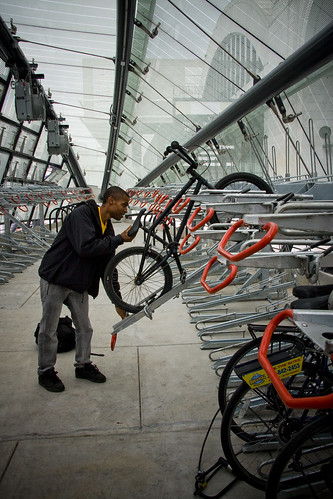
Anywho, thats what I've been doing recently, sorry about not making it last night... see y'all sunday.
Wednesday, September 30, 2009
Criteria


Here are some notes on the criteria:
[see above BMP for visual references. unfortunately blogger doesnt accept PDF files - so i had to export as a BMP - click on the image to enlarge.]
# 4.1.1 The Bicycle Design
BUILT IN components:
-GPS to generate real-live web application for smartphones, internet and available at display screens at main stations [this can be used as a planning tool by learning from patterns and therefore being able to plan in a smarter way.]
-accessories: lights, rack, basket, rear lock, solar power
RE-USE abandoned bicycles? 8,000 bicycles were abandoned in 2008 alone. In what way can these be re-used? ... create community-bonding workshops on bicycle mechanics and building workshop using these salvaged bicycles... ? Use the salvaged bicycle parts to reconstruct some of the stations?
3 types of bicycles, in 2 sizes, for a TOTAL OF 6 types of bicycles.
-townie. 3-speed. [commuter/tourist/copenhagener]
-cargo. [copenhagener]
-salvaged bicycles. [commuter/tourist/copenhagener]
2 sizes:
one to fit 4ft-5ft
one to fit 5ft+
???
# 4.1.2 Storage
Currently there are 34,800 parking spaces, including 1,000 mobile racks.
With the figure of 37% of residents biking to their school or workplace, that means that 150,000 cyclists enter Copenhangen every morning. There is a great need for more parking racks.
Solutions:
-Create more stations for the bike share, and allow for private bicycle owners to use these facilities. Private bicycle owners can tap into this system by paying a minimal yearly fee, which would help generate some revenue for the bike share program.
-Design and implement a modular parking system. These can be available for sale to commercial entities so that they can attract customers. This will create revenue for the bike share program. This type of solution would intelligently solve the issue with privatization of city sidewalks [if one exists, as it does in New York City].
-Utilize the unused wall space for a vertical parking solution.
-Utilize vacant lots for a vertical parking solution.
# 4.1.3 Booking Access and Payment
Commuter: booking and payment can be done online and/or on smartphone. Minimal annual fees for upkeep and maintenance.
Tourist: primarily deals with booking and payment at the physical stations, usually in the main squares. Payment is structured more like a minimal charged rental.
Copenhagener: booking and payment can be done online and/or on smartphone. Minimal annual fees for upkeep and maintenance.
Research other cities’ booking access and payment programs.
Paris, Lyon, Barcelona, Beijing, etc
How to generate revenue to maintain the bike share:
-modular bike racks [private commercial businesses]
-advertisement ‘space’ on bicycles and station kiosks and shelters
# 4.2.1 Overall Design Concept
Bicycle share name... ?
"If it’s monuments you’re after in Copenhagen, don’t look up. Look all around you, right there at street level. Our greatest monument is motion. It is a massive, constant, rhythmic and life-sized legacy."
free form
immediacey
dynamic
inter-connectivity
decentralized
real time
scale- micro macro
interplay
urbanity
inter reactionary
trifecta
A physical infrastructure is integral in a successful bike share [bicycles, racks, pick-up/drop off stations, bike tracks/lanes, etc]. In this proposal, a digital infrastructure is also integral in the success of the bike share [GPS on the bicycles, GIS application - Google mashup -, text messaging, etc].
GPS to generate real-live web application for smartphones, internet and available at display screens at main stations.
# 4.2.2 Design and Form
Copenhagen blue [bike lane]
Utilize a strong branding identity. [Historic emblems, color] BOLD, SYMBOLIC.
One way to think about using the city symbol: Create the station, and on the shelter, enlarge the logo so it becomes more of an abstraction.
Propose stages for implementation:
Once these stages have been created, the program can advance to a further state depending on
demand/need, as seen fit by the City.
Stage 1 - X amount of bicycles, X amount of parking spaces, X amount of stations, etc.
Stage 2 - As the program is deemed successful and there is more demand, increase in amount of bicycles, parking spaces, stations, etc.
Stage 3 - As the program expands, increase... and institute more solutions for the increase of bicycles and space for storage - use empty walls for a vertical solution; use vacant lots, etc.
Each stage becomes increasingly more complex in terms of increase of fleet, increase in parking, etc - general increase in the infrastructure.
# 4.2.3 Visibility User Friendliness and Logistics
Utilize a strong branding identity. [Historic emblems, color] BOLD, SYMBOLIC.
Utilize lighting system. Look to the symbolism in the NYC Transit system’s lighting - the glow of the Green orb when a station is open. Use the same soft, glowing but vibrant and intense type of light at the bike share stations. The stations’ level of illumination corresponds with the stations’ bicycle availability.
# 4.2.4 Interaction with the City
With growing popularity of cycling and the implementation of the new bike share, cycle track congestion proves as a challenge for city planners.
Prime motive for cycling: more and wider cycle tracks and fewer cars.
2015 GOALS:
- 50% of people will go to their work place or educational institution in Copenhagen by bike. [In 2008 , 37%]
- The number of seriously injured cyclists in Copenhagen to be halved compared to today. [118 cyclists]
- At least 80% of cyclists in Copenhagen to feel safe and secure in traffic [58%]
quick idea of how we can represent our 3 personas:

Friday, September 25, 2009
the beginning
welcome.
november 11 is our deadline.
Emily's email:
General house keeping notes
Deadline: Wednesday Nov 18 - countdown is 6.5 weeks
Our team deadline: Wednesday Nov 11 / send out our submission on Thurs Nov 12.
Regularly scheduled meetings will be on Wednesdays at 7PM. These meetings may become more frequent as the deadline approaches. We will also have a blog to discuss our ideas. [Also, in terms of dinner - perhaps we can all agree to pick up our own food en route to the meeting. Ordering takes too long. These meetings will take place at Emily's apartment, and any other places we agree upon - other team members apartments/Pratt/offices, etc. And everyone should try to make the in-person meetings, but we understand that we all have other committments. I'd ask that everyone would act responsible and let everyone know if they can't make it. We will try to have a minimum of 3 people present for each week's meeting. There is also the blog.]
Specific tasks for the next week:
Sherry - Set up the blog and tags/labels that represent the criteria.
Emily - Look for shapefiles online to use in GIS to generate CPH map. CPH transportation [bus, train] maps.
Erik - Contact brother, our groundwork counterpart. Hard copy CPH maps. Modular locking system sketch.
Zack - Register the team. We can register at the next meeting, Wed Sept 30 at 7pm. Put together a binder of the printed material.
Darius - 3D model of previously designed bicycle. Branding concepts.
General tasks for the next week:
-Team name
-Read the competition brief and familiarize oneself with the additional readings on CPH bicycle culture
-Research precedents and extract ideas that we could implement
-Bicycle design [sketches, ideas]
-Consider the provided 3 personas: Commuter, tourist, Copenhagener
-Become famliar with criteria
-Consider reaching out to an academic advisor/consultant - Ron Shiffman, Transportation Alternatives, Jeannette Sadhik-Khan, etc.
We got a lot of ideas out on the table last night. For the next meeting, let's push to have some visual represtations of our ideas so we can generate more discussion. Sketches, precedents, diagrams, color swaths - this is the time to be creative!
In terms of team name/blog URL... i was reading over the words we generated last night... and i honed in on "free form, dynamic, interconnectivity, decentralized, interplay inter reactionary" - and i thought of EMERGENCE [from wikipedia: In philosophy, systems theory and science, emergence is the way complex systems and patterns arise out of a multiplicity of relatively simple interactions. Emergence is central to the theories of integrative levels and of complex systems.] http://en.wikipedia.org/wiki/Emergence the major issue with this word is that it has been over-used in the last couple of years and it's taken a different connotation in architecture. it seems like it has become more synonymous with scripting and GC and all that fancy stuff - which I, personally, am not into. But i still believe there is validity to this term and its meaning in regards to the urban environment. Maybe there is another word that deals with emergence but in a more specific urban context rather than digital science. I'm not sure what that would be - I'm just throwing it out there for discussion :] I also think that our team name, or rather, submission/project title is of importance because it needs to reflect our overarching concept in all parts of the design - bike, share, graphics. And as discussed last night, our general concepts will become more clear as we work thru the criteria and come to a more realized solution.
november 11 is our deadline.
Emily's email:
General house keeping notes
Deadline: Wednesday Nov 18 - countdown is 6.5 weeks
Our team deadline: Wednesday Nov 11 / send out our submission on Thurs Nov 12.
Regularly scheduled meetings will be on Wednesdays at 7PM. These meetings may become more frequent as the deadline approaches. We will also have a blog to discuss our ideas. [Also, in terms of dinner - perhaps we can all agree to pick up our own food en route to the meeting. Ordering takes too long. These meetings will take place at Emily's apartment, and any other places we agree upon - other team members apartments/Pratt/offices, etc. And everyone should try to make the in-person meetings, but we understand that we all have other committments. I'd ask that everyone would act responsible and let everyone know if they can't make it. We will try to have a minimum of 3 people present for each week's meeting. There is also the blog.]
Specific tasks for the next week:
Sherry - Set up the blog and tags/labels that represent the criteria.
Emily - Look for shapefiles online to use in GIS to generate CPH map. CPH transportation [bus, train] maps.
Erik - Contact brother, our groundwork counterpart. Hard copy CPH maps. Modular locking system sketch.
Zack - Register the team. We can register at the next meeting, Wed Sept 30 at 7pm. Put together a binder of the printed material.
Darius - 3D model of previously designed bicycle. Branding concepts.
General tasks for the next week:
-Team name
-Read the competition brief and familiarize oneself with the additional readings on CPH bicycle culture
-Research precedents and extract ideas that we could implement
-Bicycle design [sketches, ideas]
-Consider the provided 3 personas: Commuter, tourist, Copenhagener
-Become famliar with criteria
-Consider reaching out to an academic advisor/consultant - Ron Shiffman, Transportation Alternatives, Jeannette Sadhik-Khan, etc.
We got a lot of ideas out on the table last night. For the next meeting, let's push to have some visual represtations of our ideas so we can generate more discussion. Sketches, precedents, diagrams, color swaths - this is the time to be creative!
In terms of team name/blog URL... i was reading over the words we generated last night... and i honed in on "free form, dynamic, interconnectivity, decentralized, interplay inter reactionary" - and i thought of EMERGENCE [from wikipedia: In philosophy, systems theory and science, emergence is the way complex systems and patterns arise out of a multiplicity of relatively simple interactions. Emergence is central to the theories of integrative levels and of complex systems.] http://en.wikipedia.org/wiki/Emergence the major issue with this word is that it has been over-used in the last couple of years and it's taken a different connotation in architecture. it seems like it has become more synonymous with scripting and GC and all that fancy stuff - which I, personally, am not into. But i still believe there is validity to this term and its meaning in regards to the urban environment. Maybe there is another word that deals with emergence but in a more specific urban context rather than digital science. I'm not sure what that would be - I'm just throwing it out there for discussion :] I also think that our team name, or rather, submission/project title is of importance because it needs to reflect our overarching concept in all parts of the design - bike, share, graphics. And as discussed last night, our general concepts will become more clear as we work thru the criteria and come to a more realized solution.
down here in our gray frame it says "labels for this post" and thats where all of our tags are!
Subscribe to:
Posts (Atom)