Tuesday, December 1, 2009
Tuesday, November 10, 2009
Monday, November 9, 2009
PAGE 12
Page 4 and Page 5
PAGE 4:
Isabella is on the train to København from Hamburg, and she recalls running into a fellow backpacker who informs her about København’s new bike share, Kø.
She decides to enable her wifi card on her laptop so she can check out the Kø bike share’s website. She remembers hearing how easy it was to use and a great way to get around the city.
The website’s main purpose is to generate membership with the Kø bike share program. The membership durations range from 24 hours to 12 months, purposely allowing for all types of users to gain access to the program. For instance, a tourist would likely sign up for a 7 day membership; while a commuter would may opt for a 30 day or 12 month membership. The 24 hour membership is intended for first time users who want to explore the system before committing, or for those who enjoy using the bike share but will do so infrequently. All membership fees will be determined in the future once a survey is conducted to find the appropriate price point.
The web-based membership sign-up will enable the city of København to keep track of how many users they have. This tracking system will allow the city to monitor the demand and need for more bicycles and necessary infrastructure. Another advantage to this system is to keep track of payment. When a user provides their credit card information for the initial membership fees, then they can be accountable [billed] for their use of the bike share when their trips exceed 30 minutes. This form of billing will be explained in more detail in the Terms and Agreements. Lastly, the web-based application will allow members to log-in when they want to re-new membership, and also review customized information, ie: their history of pick-up and drop-off locations to create a sense of ownership and an awareness of their interaction with the city.
Isabella is in København for 6 days, so she opts for the 7 day membership and pays by credit card.
[text on the page is not in line with the booklet template.]
Isabella and her friend check into their hotel, and then they venture out into the København to explore the city. They’ve decided to utilize the Kø bike share in order to get around the city. They specifically want to see Christiania.
At the Kø silo in the major square near Langebro, Isabella picks up her pre-paid Kø card.
When Isabella is at the Kø kiosk, she is prompted to swipe her credit card so that the machine can identify her pre-paid membership.
Then the interactive LCD screen informs her of the specifics of the Kø bike share program: First 30 minutes are free. Every time the bicycle is unlocked, the first free 30 minutes starts.
If she runs over the 30 minutes, then she will be incrementally charged 10 DKK, on her credit card. And as an incentive to promote membership with the Kø bike share program, Isabella receives an additional perk with her pre-paid Kø card; one example of this would be a coupon for a discount into the Tivoli Gardens or a discount at a local cafe.
Isabella’s friend pays by cash, including the low-fee deposit, in order to obtain a Kø card. We recommend the cash deposit to be in the amount of 250DKK. Another way to obtain the Kø card by paying with cash is at a local business partner that sells the card. The Kø card can be returned to any of the Kø silos or kiosks located at main transportation hubs throughout the city; ie: Central Station or the Airport.
The girls obtain their Kø bike share bicycles and head out to Christiania.
[collage subject to change when we have more finished renderings]
[text on the page is not in line with the booklet template.]
if you have any comments, please share. thanks!
**updates in bold
Wednesday, November 4, 2009
Logistics: booking, access + payment - UPDATE

note: the right hand section will be filled with specs and a silhouetted diagram of people's sizes and what bicycle they should select.


note: will add some text above the blackberries. also, may insert renderings into the right hand section rather than the shape diagram.
Friday, October 30, 2009
Useful links - Check them out
Paying with a cell phone: http://bits.blogs.nytimes.com/2009/10/29/using-a-cellphone-number-to-pay-for-virtual-goods/?hp
RFID and Danish bikes: http://www.treehugger.com/files/2007/12/rfid_lights_up.php
http://www.see-mi.dk/Default.aspx?ID=91
Private bike rental and pricing in Kobenhavn: http://cykelboersen.dk/en/priser/
http://www.cph-bike-rental.dk/
Wednesday, October 28, 2009
...look what i made!


I've got a .skp file i can e-mail if anyone wants to play with it and get a specific view. I'm going to work on building the silo in sketchup (finally) today/tonight and then I'm going to photoshop them into some of the images Brandon took so they look at home, and that should provide us with some good visual material for the booklet/boards.
Please let me know what you think about this scheme for a "satellite hub" to the share system. Each Bollard is a stand-alone unit that is hard-wired into the municipal utilities, and is a secure way to store the Kø bikes as well as privately owned bicycles.
Features:
- RFID Reader aligns with head-tube of Kø bike (where RFID tag will go) and communicates with the real-time database for the online component.
- Powder coated steel bollard and lock-ring adequitely resist corrosion in harsh and salinated conditions (seaside)
- User Interface features standard 10 button numerical pad for manual operation (non-member use), a short-range RFID reader compatible with bank cards and membership card, a magnetic strip swipe for standard bank/credit cards; and a big, friendly screen for visual confirmation and information.
- A happy looking flower pot is integrated into the top of the prefabricated bollard and filled with soil and a nice flower. The pot drains through a week-hole (not modeled) at the base of the bollard to allow for the plant's natural aspiration from both above and below.
- Nice blue colour mimics that of the copenhagen bike lanes, reaffirming their connection to Copenhagen's transportation and ambulation network.
I figured the lock ring going around the head tube was the simplest and most efficient manner for locking given the propensity for trash and scum to collect in those wheel-slot locking systems. I think we should definitely use more economical anti-wheel-theft solutions such as keyed skewers:
The maintenance worker could be the only ones with access to a key that would release the wheel.
Also, I know the bike is red and not yellow like in Philip's diagrams, but a.) that color can be quickly changed in sketchup; and b.) red or yellow bollards look either like safety equipment or dumb so blue, being the next primary color, worked best and looked the nicest to me, but then with a bunch of yellow bikes all around it started to look like a lo-fi IKEA ad.
Finally, I know the bike isn't quite the same as Philip's design, I tried to find a model of a city bike that I could tweak to look like ours but this was as close as I could get without surpassing my abilities in sketchup/modeling for days on end...
Wednesday, October 21, 2009
a little bit of this, a little bit of that

quickie collages using erik's sketches, philip's bicycle and interactive booth/dispenser:


the red, yellow and blue isnt 100% on point... i really like the yellow and blue together [but as erik mentioned, this may be too SWEDISH - noooooo!] i like how philip used the two tones of blue and yellow as the main component colors with an accent of red.
this definitely needs a big helping of REFINEMENT. tonight, Erik and I have discussed that we will work on how the booking, access and payment [booth/dispenser] can be integrated in with the storage [silo]. i will also continue to work on simulating the web/smart phone web applications. see you all tonight!
Tuesday, October 20, 2009
...scans n' things
First there was this thing:

Not terribly relevant now, I know, but here for the sake of posterity nonetheless.Next is that silly diagram thing I did explaining how bikes would be dredged out of the harbor for re-use... While I agree with Philip that this might not be the best idea for bikes intended to be ridden, perhaps a similar diagram could be used to explain how they are converted into bike racks, for instance.

And then there's the silo...
conceptual sketch
sketch showing implementation in front of the størmagasinet. (I think this one looked a lot better before I got all whimsical with the colouring.)
Sketch showing broader implementation at the Kongens Nytorv metro station.
In photoshop, I added some moody tones. Strangely, whenever I imagine Copenhagen, it's always dark out...
And then some colour... (As I mentioned above, for some reason, I frequently feel as though I destroy some of my best sketches by colouring them, but photoshop proved to be an ally in that regard [note the awesome foliage I added!!])
Saturday, October 17, 2009
logistsics: booking, access + payment

4.1.1 THE BICYCLE DESIGN
What will the bicycle in the future bike share system look like?
Mixte bike frame, yellow color. Carbon Belt System. Built-in lights and basket. Carbon belt system. Two sizes: small and large.
Cargo bike
How will it work?
4.1.2 Storage
How is the bicycle stored when not in use?
Silos. Hexagonal wire mesh with green indigenous plants IN DRAWING:[include lighting, air pumps, interactive touch-screen LCD panel with the Ko website - for booking and payment purposes -, RFID card dispenser, unique silo number - for access thru text message]
Ballards
Re-cycled salvaged bicycle parts
4.1.3 [LOGISTICS] BOOKING, ACCESS AND PAYMENT
How do you book a bicycle from the bike share system?
There are a number of options, one is going to the “Ko” website and booking a bicycle from there.
Book a bicycle at the silos with a touch-screen LCD panel with the website.
How do you access a bicycle and drop it off again?
Radio Frequency IDentification [RFID]
How does the user pay/register for usage?
There will be RFID integrated in the new bike share bicycles to keep track of them in the system
[to be displayed on the web/phone application] and also as a direct form of sorting in the storage system.
There will be RFID cards for members to be obtained from signing up on the website
and then to be dispensed from the vending machines at the parking storage system.
If bicyclists with their own privately-owned bicycles wish to park their bicycles at the “Ko” silo, they will incur a minimal charge.
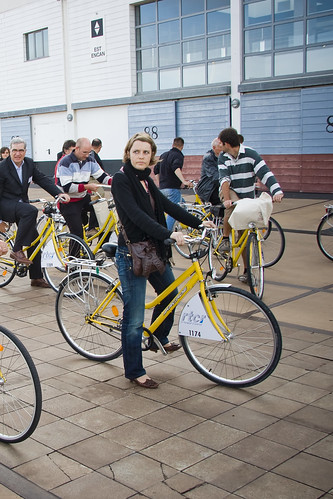
La Rochelle's bike share uses yellow bikes... http://www.copenhagencyclechic.com/2009/10/french-bicycle-advocate-cycle-chic.html
...Ninjas on the net
Fun stuff to say the least. Check out Ninjas on the Net posts here. There are lots of really interesting things linked in the posts too, though much of it would be only loosely related to what we're working on.
Anyway, i thought some of these might inform our graphic description of the network of bikes throughout danmark. perhaps we could make some approximation of useage and directionality and make a sweet map that could serve as an example of what their traffic analysts and urban planners would see from the incessant stream of RFID and GPS information coming in.
See y'all soon...
Monday, October 12, 2009
SMIT's GROW
All this talk about ivy covered bike silos and solar and wind power harvesting has me thinking about the group SMIT and their research product GROW. The team was founded by a Pratt ID student and his sister the main product of the venture being his thesis project. I do believe most of us know their newest partner Ben Howes who graduated from Pratt architecture in '06. The system uses bio-mimicking leaf shaped pieces to harness solar and wind power.
"...GROW employs thin film photovoltaics with piezoelectric generators and screen printed conductive ink encapsulated in ETFE fluoropolymer lamination... Based around a modular brick system, GROW is composed of a small number of different parts. Each brick has 5 solar leaves which have a very flexible piezo generator at their stem. The manufacturing of these bricks could happen in a roll to roll printing process where PV, conductive ink, and piezo generators can be layered quickly and efficiently. The rolls can then be stamped and formed to create leaves and connection points. Each brick is designed so that at the end of their life cycle the valuable components, i.e. photovoltaic and piezo, can be stamped out and up cycled while the reusable material, i.e plastic, can be up recycled back into the production stream."
This is the blog from their early days in the venture and their current official site. Their solar ivy is due out this fall as a full working prototype/product line.
Sunday, October 11, 2009
bikeoff
...and the bike parking guidelines may as well be the closest thing i have seen to a bicycle rack graphic standards.... there is a pretty involved wiki and parking guidelines consultation blog
Monday, October 5, 2009
some reading
david byrne's account of BIXI sept 5 2009
supposedly BIXI is coming to NYC soon.
journal entry contains photos of the bicycle and the payment system.
BIXI system
BICYCLE + TAXI = BIXI

more david byrne accounts of biking sept 11 2009, a la zack.
A Talking Head Dreams of a Perfect City Osaka's robot-run parking lots mixed with the Minneapolis lakefront; a musician's fantasy metropolis
Worst bike share according to Copenhagenize oct 2 2009
Capitol Hill, in Washington, DC. - Wheels4Wellness
another good Copenhagenize blog post - this time, about the UN Climate Conference to be held in CPH. Apparently only 200 bikes will be lent to the 10,000 delegates expected. [By the way, the winner of the CPH Bike Share competition will be announced at the UN Climate Conference in CPH in December.] An excerpt to consider in the discussion of re-use and recycling:
"Listen... we scrap 400,000 bicycles each year in Denmark. Scrap 'em. Gone. Bye bye. The cities in Denmark are constantly removing bicycles from outside train stations. Many of them are sold at police auctions. Stolen bikes that are later found are given to the insurance company that now owns them. They don't know what to do with them. An organisation like Baisikeli has figured out that they can get a hold of them and send them to workshops in Africa. Copenhagen and Denmark could easily provide a few thousand bicycles. Even one bicycle for every delegate if we really put our mind to it. Plus bicycles for the press, the NGO's, the activists.There is no shortage of bicycles. Hell, we could dredge the canals of Copenhagen in one sweep and find bicycles enough for all the delegates from Australasia. Get them fixed up nice. The very first City Bikes in our bike share system were repaired and maintained at the bike shop at one of the prisons in the city. That's just one idea."
bike-sharing blog
international info on bike share programs
Wednesday, September 30, 2009
Criteria


Here are some notes on the criteria:
[see above BMP for visual references. unfortunately blogger doesnt accept PDF files - so i had to export as a BMP - click on the image to enlarge.]
# 4.1.1 The Bicycle Design
BUILT IN components:
-GPS to generate real-live web application for smartphones, internet and available at display screens at main stations [this can be used as a planning tool by learning from patterns and therefore being able to plan in a smarter way.]
-accessories: lights, rack, basket, rear lock, solar power
RE-USE abandoned bicycles? 8,000 bicycles were abandoned in 2008 alone. In what way can these be re-used? ... create community-bonding workshops on bicycle mechanics and building workshop using these salvaged bicycles... ? Use the salvaged bicycle parts to reconstruct some of the stations?
3 types of bicycles, in 2 sizes, for a TOTAL OF 6 types of bicycles.
-townie. 3-speed. [commuter/tourist/copenhagener]
-cargo. [copenhagener]
-salvaged bicycles. [commuter/tourist/copenhagener]
2 sizes:
one to fit 4ft-5ft
one to fit 5ft+
???
# 4.1.2 Storage
Currently there are 34,800 parking spaces, including 1,000 mobile racks.
With the figure of 37% of residents biking to their school or workplace, that means that 150,000 cyclists enter Copenhangen every morning. There is a great need for more parking racks.
Solutions:
-Create more stations for the bike share, and allow for private bicycle owners to use these facilities. Private bicycle owners can tap into this system by paying a minimal yearly fee, which would help generate some revenue for the bike share program.
-Design and implement a modular parking system. These can be available for sale to commercial entities so that they can attract customers. This will create revenue for the bike share program. This type of solution would intelligently solve the issue with privatization of city sidewalks [if one exists, as it does in New York City].
-Utilize the unused wall space for a vertical parking solution.
-Utilize vacant lots for a vertical parking solution.
# 4.1.3 Booking Access and Payment
Commuter: booking and payment can be done online and/or on smartphone. Minimal annual fees for upkeep and maintenance.
Tourist: primarily deals with booking and payment at the physical stations, usually in the main squares. Payment is structured more like a minimal charged rental.
Copenhagener: booking and payment can be done online and/or on smartphone. Minimal annual fees for upkeep and maintenance.
Research other cities’ booking access and payment programs.
Paris, Lyon, Barcelona, Beijing, etc
How to generate revenue to maintain the bike share:
-modular bike racks [private commercial businesses]
-advertisement ‘space’ on bicycles and station kiosks and shelters
# 4.2.1 Overall Design Concept
Bicycle share name... ?
"If it’s monuments you’re after in Copenhagen, don’t look up. Look all around you, right there at street level. Our greatest monument is motion. It is a massive, constant, rhythmic and life-sized legacy."
free form
immediacey
dynamic
inter-connectivity
decentralized
real time
scale- micro macro
interplay
urbanity
inter reactionary
trifecta
A physical infrastructure is integral in a successful bike share [bicycles, racks, pick-up/drop off stations, bike tracks/lanes, etc]. In this proposal, a digital infrastructure is also integral in the success of the bike share [GPS on the bicycles, GIS application - Google mashup -, text messaging, etc].
GPS to generate real-live web application for smartphones, internet and available at display screens at main stations.
# 4.2.2 Design and Form
Copenhagen blue [bike lane]
Utilize a strong branding identity. [Historic emblems, color] BOLD, SYMBOLIC.
One way to think about using the city symbol: Create the station, and on the shelter, enlarge the logo so it becomes more of an abstraction.
Propose stages for implementation:
Once these stages have been created, the program can advance to a further state depending on
demand/need, as seen fit by the City.
Stage 1 - X amount of bicycles, X amount of parking spaces, X amount of stations, etc.
Stage 2 - As the program is deemed successful and there is more demand, increase in amount of bicycles, parking spaces, stations, etc.
Stage 3 - As the program expands, increase... and institute more solutions for the increase of bicycles and space for storage - use empty walls for a vertical solution; use vacant lots, etc.
Each stage becomes increasingly more complex in terms of increase of fleet, increase in parking, etc - general increase in the infrastructure.
# 4.2.3 Visibility User Friendliness and Logistics
Utilize a strong branding identity. [Historic emblems, color] BOLD, SYMBOLIC.
Utilize lighting system. Look to the symbolism in the NYC Transit system’s lighting - the glow of the Green orb when a station is open. Use the same soft, glowing but vibrant and intense type of light at the bike share stations. The stations’ level of illumination corresponds with the stations’ bicycle availability.
# 4.2.4 Interaction with the City
With growing popularity of cycling and the implementation of the new bike share, cycle track congestion proves as a challenge for city planners.
Prime motive for cycling: more and wider cycle tracks and fewer cars.
2015 GOALS:
- 50% of people will go to their work place or educational institution in Copenhagen by bike. [In 2008 , 37%]
- The number of seriously injured cyclists in Copenhagen to be halved compared to today. [118 cyclists]
- At least 80% of cyclists in Copenhagen to feel safe and secure in traffic [58%]
quick idea of how we can represent our 3 personas: